Starting an apparel brand is not only about creating a great design. The manufacturer you choose can directly affect your product quality, production cost, delivery time, customer satisfaction, and brand reputation.
A manufacturer that looks affordable at first may become expensive if samples are poor, communication is slow, minimum order quantities are too high, or production does not match your original design.
Whether you are launching a small clothing brand, developing custom activewear, producing sportswear, or preparing a larger apparel collection, choosing the right manufacturing partner requires careful evaluation.
In this guide, we will explain the most important factors to consider before selecting a clothing manufacturer.
Before contacting manufacturers, clearly define your product requirements.
For example, are you producing:
Different products require different manufacturing capabilities.
A factory experienced in basic cotton T-shirts may not necessarily have the technical expertise required for compression garments, sublimation sportswear, rash guards, or performance apparel.
Having these answers ready makes it much easier to identify suitable manufacturers.
One of the biggest mistakes new clothing brands make is choosing a manufacturer simply because they offer a low price.
Instead, look at their experience with your specific type of garment.
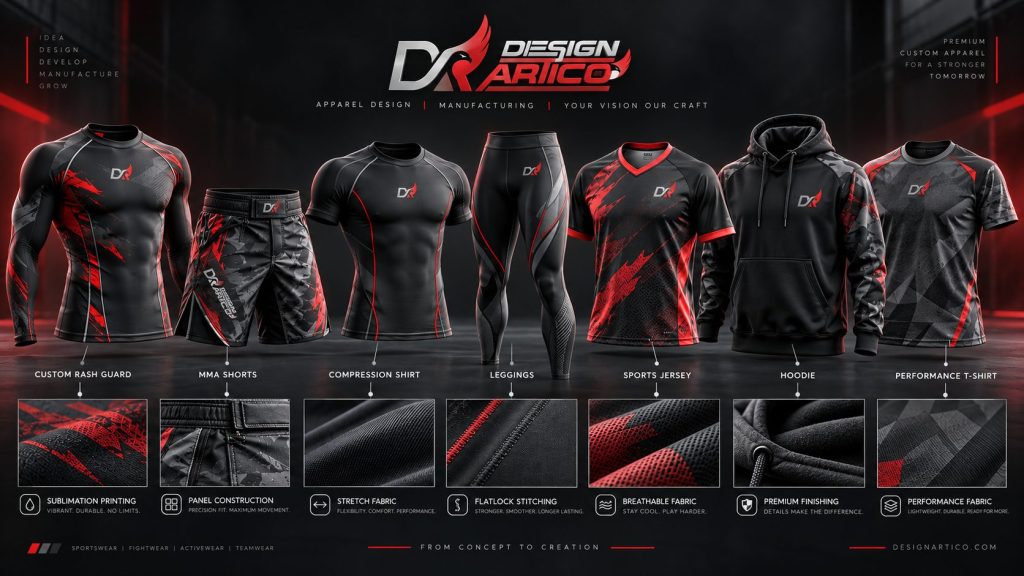
For example, if you are developing a performance rash guard, the manufacturer should understand:
Similarly, an MMA or BJJ apparel manufacturer should understand the requirements of combat sports garments rather than treating the product like a standard T-shirt.
Don’t only ask:
“Can you manufacture clothing?”
Ask:
“Have you manufactured this exact type of garment before?”
Then request photographs, samples, or examples of similar production.
Fabric selection has a major impact on the final product.
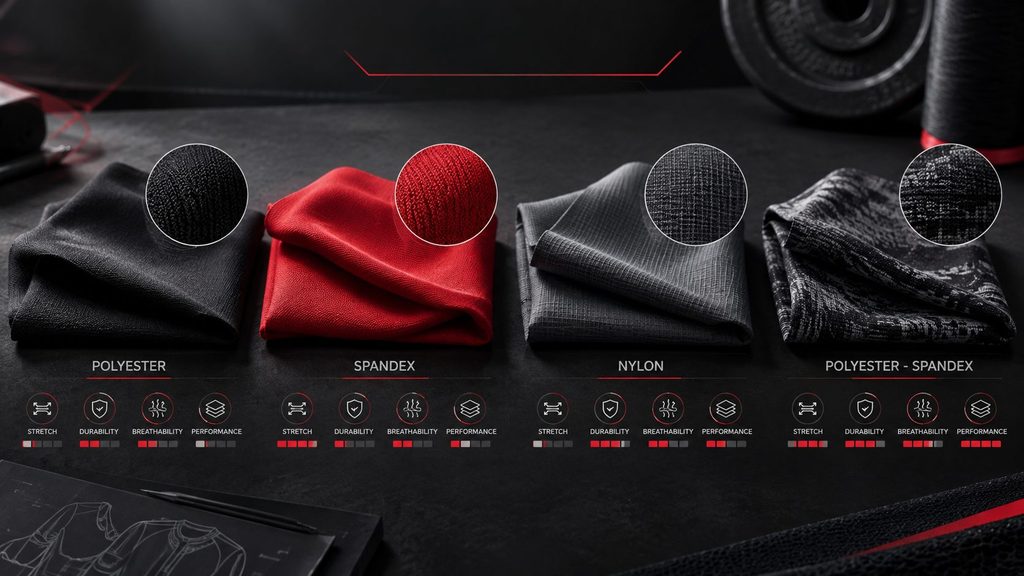
For activewear, common materials include:
The right fabric depends on the product’s intended use.
For example, performance apparel may require stretch, moisture management, durability and recovery, while a casual fashion garment may prioritize softness, weight and appearance.
Don’t simply select fabric based on the cheapest price.
Instead, evaluate:
Fabric composition → GSM → stretch → recovery → hand feel → durability → intended use
Your manufacturer should be able to provide clear fabric specifications and, ideally, physical samples.
MOQ means Minimum Order Quantity.
This is the minimum number of pieces a manufacturer requires you to order.
For a new brand, MOQ is extremely important because you don’t want to invest heavily in inventory before knowing whether your product will sell.
For example, one manufacturer may accept a relatively small initial order while another may require hundreds or thousands of pieces.
Ask:
Low MOQ is useful for testing a product, but manufacturing quality, communication and pricing still matter.
The goal is to find the right balance between:
MOQ + quality + price + production capability.
A production sample gives you the opportunity to evaluate the product before committing to bulk manufacturing.
This is particularly important for technical apparel.
Check the sample for:
Never assume that a digital design will automatically translate perfectly into a physical garment.
The sample stage is where you identify problems before they become expensive production problems.
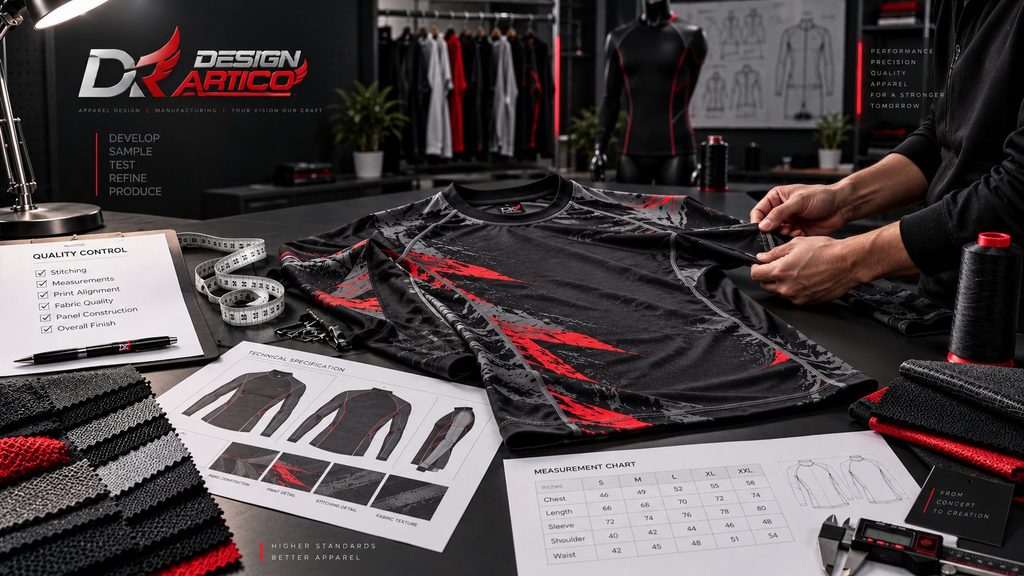
A professional manufacturer needs clear production information.
This is where a tech pack becomes extremely valuable.
A good apparel tech pack can communicate details such as:
For complex sportswear and activewear, production-ready artwork and technical documentation can significantly reduce misunderstandings between the designer, manufacturer and production team.
If a manufacturer says they can produce your garment but cannot clearly explain what production information they require, clarify this before placing an order.
Your manufacturer should understand the printing method required for your garment.
Common apparel printing methods include:
Commonly used for polyester-based sportswear and performance apparel.
Useful for certain garment applications and graphic placements.
Common for traditional apparel graphics and larger production runs.
The important thing is not simply knowing the printing method. The manufacturer should understand how that method interacts with the fabric, artwork, garment construction and production process.
For engineered sportswear, artwork positioning and panel alignment are particularly important.
Never compare manufacturers based only on the price per piece.
Your actual manufacturing cost can include:
Garment cost + sampling + labels + packaging + artwork/setup + shipping + customs/duties + other production costs
A manufacturer quoting $8 per piece may ultimately cost more than one quoting $10 if the first supplier has expensive sampling, poor quality, higher shipping or hidden fees.
Ask for a complete quotation.
Ideally, request pricing for:
This gives you a clearer picture of how the unit price changes with production volume.
Communication is often overlooked.
Before committing to production, evaluate:
If communication is already difficult during the quotation stage, it may become more difficult once you have paid for production.
A good manufacturing relationship requires clear communication from both sides.
Ask the manufacturer how quality is checked during production.
Important questions include:
For a growing apparel brand, consistent quality matters because your customers experience the finished product, not the manufacturing process.
Ask for realistic timelines rather than assuming the manufacturer can meet your preferred deadline.
Separate the timeline into:
Sample development → Sample approval → Bulk production → Quality control → Packing → Shipping
This makes the entire process easier to manage.
Also ask whether the production timeline starts:
Getting this clarification in writing can prevent unnecessary delays.
If you are building your own apparel brand, ask whether the manufacturer supports:
Private-label options can help transform a generic manufactured garment into a product that feels like part of your own brand.
A manufacturer can only produce what they understand.
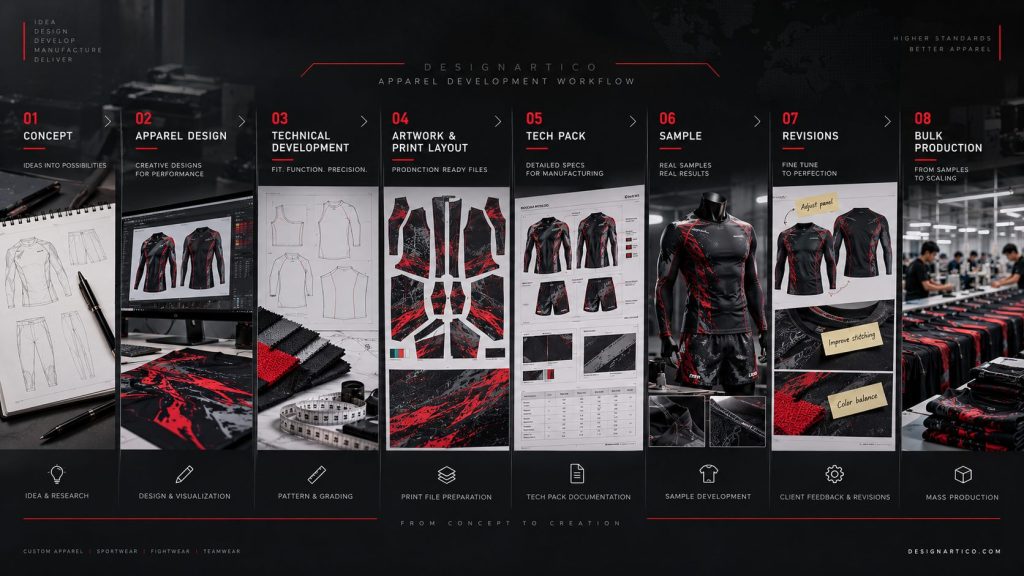
A professional apparel design workflow should ideally move through:
Concept → Design → Technical Development → Artwork → Tech Pack → Sample → Revisions → Production
Skipping the technical development stage can create problems later.
For example, artwork may look perfect on a flat design but fail when applied to actual garment panels.
This is especially important for:
Before selecting a manufacturer, compare suppliers using the same criteria.
| Factor | Manufacturer A | Manufacturer B | Manufacturer C |
|---|---|---|---|
| Product expertise | ✓ | ✓ | — |
| MOQ | Low | Medium | High |
| Sample quality | ✓ | ✓ | — |
| Fabric options | ✓ | ✓ | ✓ |
| Custom labels | ✓ | — | ✓ |
| Printing capability | ✓ | ✓ | — |
| Communication | ✓ | — | ✓ |
| Production time | Fast | Medium | Slow |
| Price | $$ | $ | $$$ |
| Quality | High | Medium | High |
This makes the decision more objective.
The best manufacturer isn’t necessarily the cheapest one.
A strong manufacturing partner should offer a combination of:
✓ Relevant experience
✓ Consistent quality
✓ Reasonable MOQ
✓ Reliable communication
✓ Suitable fabrics
✓ Accurate sampling
✓ Production capabilities
✓ Clear pricing
✓ Quality control
✓ Reliable delivery
Think about manufacturing as a long-term partnership, not simply a one-time purchase.
Choosing a manufacturer is only one part of developing a successful apparel product.
Before production, your manufacturer needs accurate design artwork, technical specifications and production-ready files.
DesignArtico works with apparel brands on custom sportswear and performance apparel development, including:
The goal is to make the transition from design concept to manufacturing clearer and more production-ready.
Need apparel artwork or technical design support for your next collection? Contact DesignArtico to discuss your project.
Look at product expertise, MOQ, fabric options, sample quality, production capabilities, communication, quality control, pricing and delivery times.
MOQ stands for Minimum Order Quantity. It is the minimum number of garments a manufacturer requires you to order.
Yes. A sample allows you to check fit, fabric, construction, printing, measurements and finishing before committing to a larger production run.
For many custom garments, especially technical apparel, a detailed tech pack can help communicate measurements, construction, materials, colors and production requirements more accurately.
Compare manufacturers using the same criteria: MOQ, quality, sample process, fabric options, printing capabilities, pricing, communication and production timeline.
Choosing the right clothing manufacturer is one of the most important decisions an apparel brand makes.
Don’t choose based on price alone.
Evaluate the manufacturer’s experience, product capabilities, MOQ, materials, sampling process, quality control, communication and production reliability.
Most importantly, make sure your designs and technical specifications are properly prepared before production begins.
A strong combination of good product development + clear production documentation + the right manufacturing partner gives your apparel brand a much better foundation for consistent production.