

Polyester vs Spandex vs Nylon: Which Fabric Is Best for Activewear?
Choosing the right fabric is one of the most important decisions when developing custom activewear. The material you select affects how a garment feels, stretches, handles moisture, maintains its shape and performs during physical activity.
Polyester, spandex and nylon are three widely used synthetic fibers in sportswear and performance apparel. Each has different characteristics, and choosing the right one depends on the type of garment you want to manufacture.
For example, a polyester-spandex blend may be suitable for sublimated sportswear, while nylon-spandex can be a strong option for fitted leggings and compression garments.
But which material is actually best?
In this guide, we’ll compare polyester, spandex and nylon, explain their properties, explore common fabric blends and help apparel brands select suitable materials for different activewear products.
1. Understanding the Three Main Activewear Fibers
Before comparing these materials, it’s important to understand what each fiber contributes to a garment.
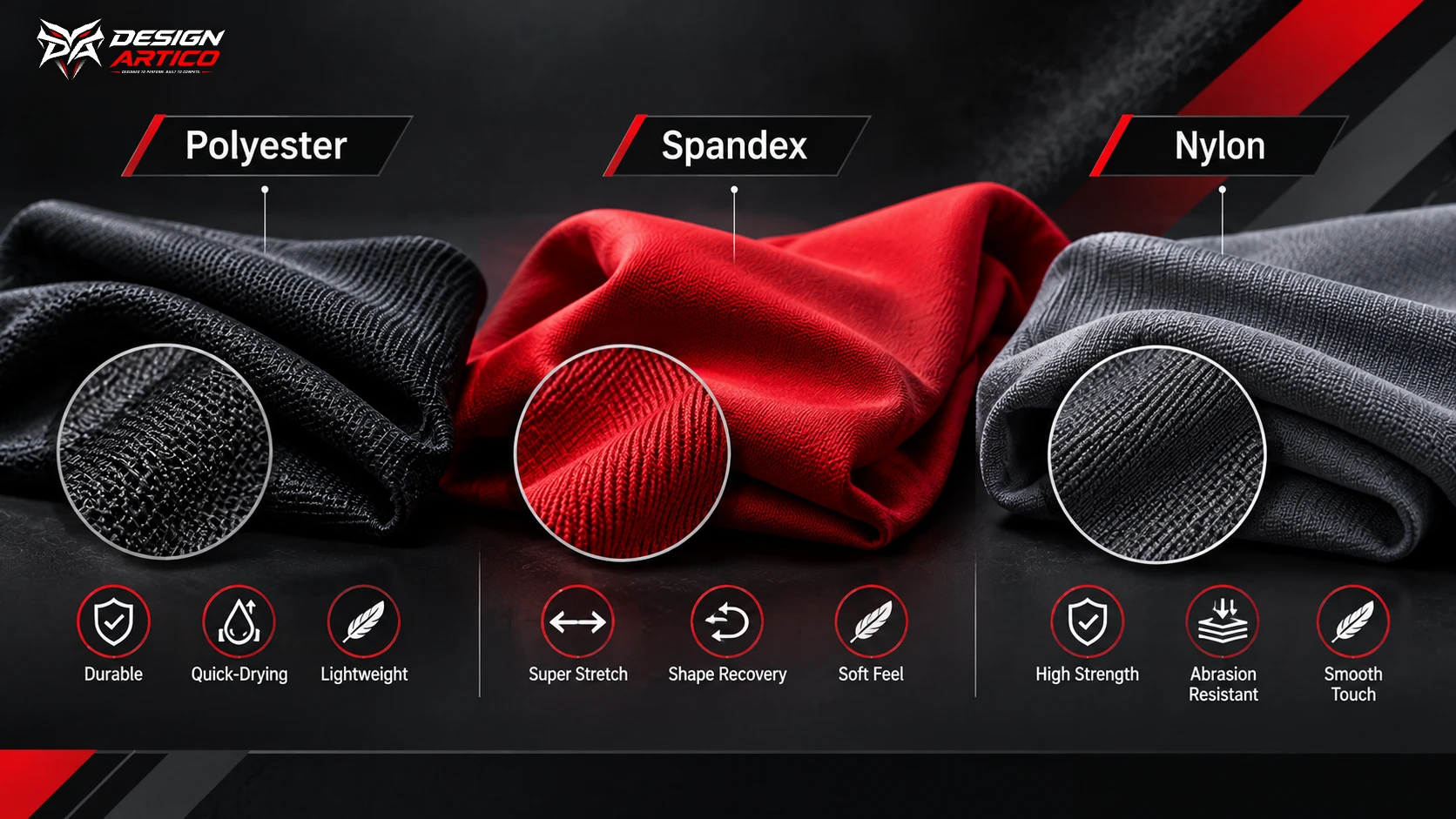
Polyester
Polyester is one of the most commonly used fibers in sportswear manufacturing.
It is valued for its durability, dimensional stability, easy care and suitability for various performance fabric constructions.
Key characteristics:
- Lightweight options available
- Good dimensional stability
- Durable and abrasion-resistant
- Generally quick-drying
- Suitable for sublimation when using compatible polyester fabric
- Available in different fabric weights and knit structures
Common applications:
- Sports jerseys
- Performance T-shirts
- Gym wear
- MMA rash guards
- Running apparel
- Training shorts
One important point: polyester fibers have relatively low moisture absorption. Moisture-wicking performance depends on yarn structure, fabric construction and finishing, not just the fiber name.
Spandex (Elastane)
Spandex, also known as elastane, is primarily used to provide stretch and recovery.
It is rarely selected as the only fiber in a performance garment. Instead, it is blended with polyester or nylon to improve flexibility and fit.
Key characteristics:
- Excellent elasticity
- Stretch and recovery
- Supports close-fitting garments
- Helps garments maintain their shape
- Suitable for compression-style apparel
Common applications:
- Compression shirts
- Leggings
- Rash guards
- Cycling apparel
- Sports bras
- Fitted training wear
Spandex is particularly important when a garment needs to stretch with the body and recover its original shape.
Nylon
Nylon is another important synthetic fiber used in performance apparel.
It is known for its strength, smooth feel and abrasion resistance, making it useful in garments that require durability and comfort.
Key characteristics:
- High strength
- Smooth hand feel
- Good abrasion resistance
- Lightweight fabric options
- Suitable for stretch blends
- Available in different performance constructions
Common applications:
- Performance leggings
- Compression wear
- Training apparel
- Sports bras
- Athletic tops
- Outdoor performance clothing
Nylon’s moisture and drying behavior can vary with yarn and fabric construction, so physical testing remains important.
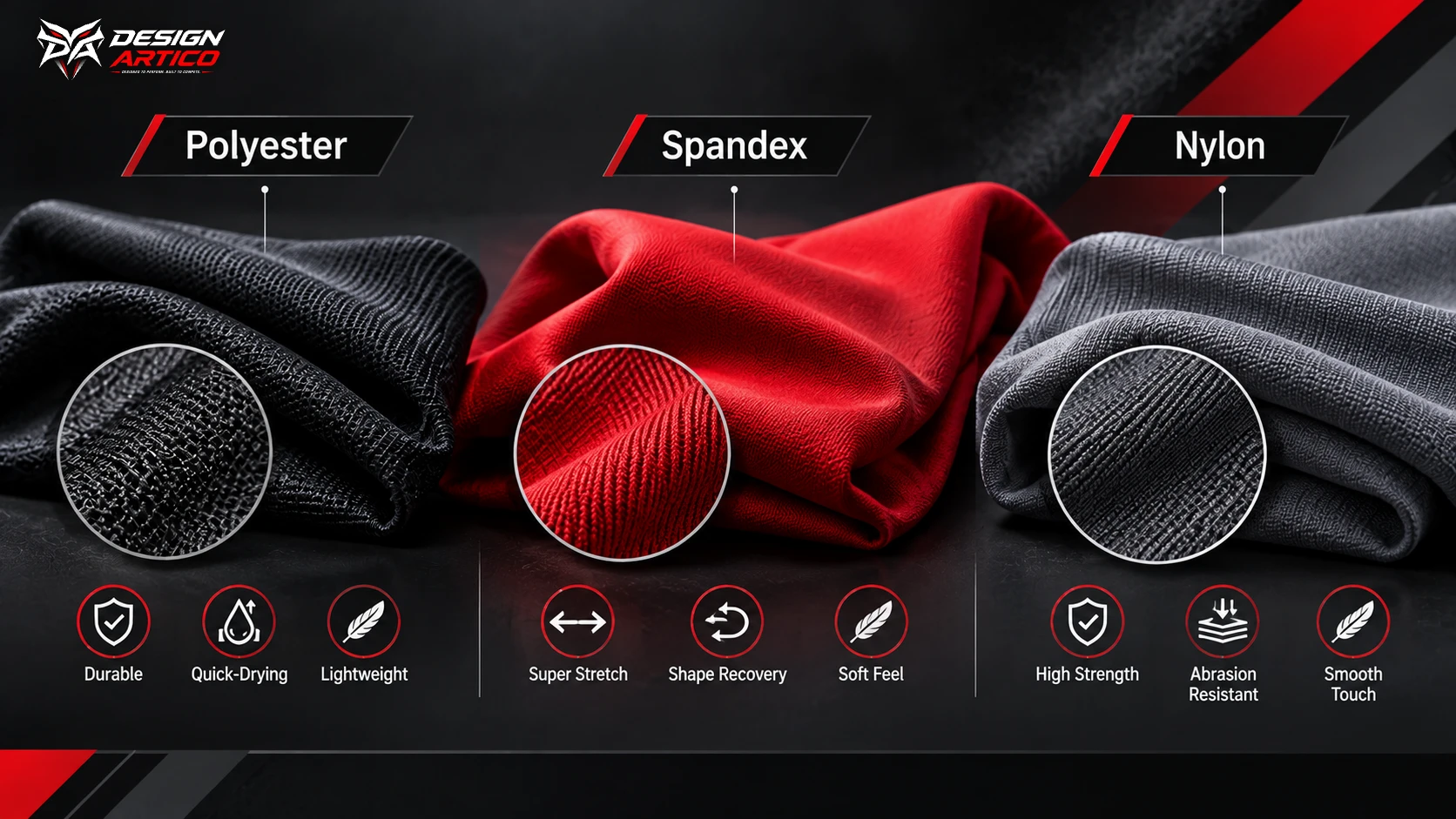
2. Polyester vs Spandex vs Nylon: Main Differences
Although these fibers are often used together, they serve different purposes in activewear development.
| Property | Polyester | Spandex | Nylon |
|---|---|---|---|
| Main purpose | Performance base fiber | Stretch and recovery | Strength and comfort |
| Stretch | Depends on construction | Excellent | Depends on construction |
| Durability | Good | Good in blends | Very good |
| Hand feel | Varies | Smooth and flexible | Often smooth and soft |
| Moisture behavior | Low absorption; can wick | Not primarily a moisture-management fiber | Depends on construction |
| Sublimation | Suitable when compatible | Not generally used as the main print base | Not the usual choice for standard polyester sublimation |
| Common use | Jerseys and sportswear | Compression garments | Leggings and fitted apparel |
Important: These are general fiber characteristics, not guaranteed fabric performance ratings. The actual result depends on yarn, knit structure, blend percentage, finishing and garment construction.
3. Why Polyester-Spandex Is Popular in Sportswear
Polyester-spandex is a widely used combination in performance apparel.
It combines polyester’s useful characteristics as a fabric base with the elasticity of spandex.
This makes it suitable for products that need both visual flexibility and functional movement.
Common applications
- Custom sports jerseys
- Performance T-shirts
- MMA rash guards
- BJJ rash guards
- Training tops
- Compression apparel
For sublimated sportswear, polyester content is especially relevant because conventional sublimation printing is designed for compatible polyester-based materials.
However, brands should always confirm the exact fabric composition and printing requirements with their manufacturer.
What should you check?
- Polyester percentage
- Spandex percentage
- Fabric GSM
- Four-way stretch
- Stretch recovery
- Surface texture
- Print compatibility
- Color consistency
Do not assume that every polyester-spandex blend will perform identically.
4. Why Nylon-Spandex Is Used for Premium Activewear
Nylon-spandex blends are frequently considered for products where softness, flexibility and abrasion resistance are important.
These blends are particularly relevant to fitted garments that maintain close contact with the body.
Common applications
- Yoga leggings
- Compression leggings
- Performance shorts
- Sports bras
- Fitted training tops
- Premium fitness apparel
Nylon-spandex fabrics can offer a smooth hand feel and flexibility, but the exact performance depends on the construction and blend ratio.
For apparel brands, the best approach is to compare physical fabric samples instead of choosing based on fiber composition alone.
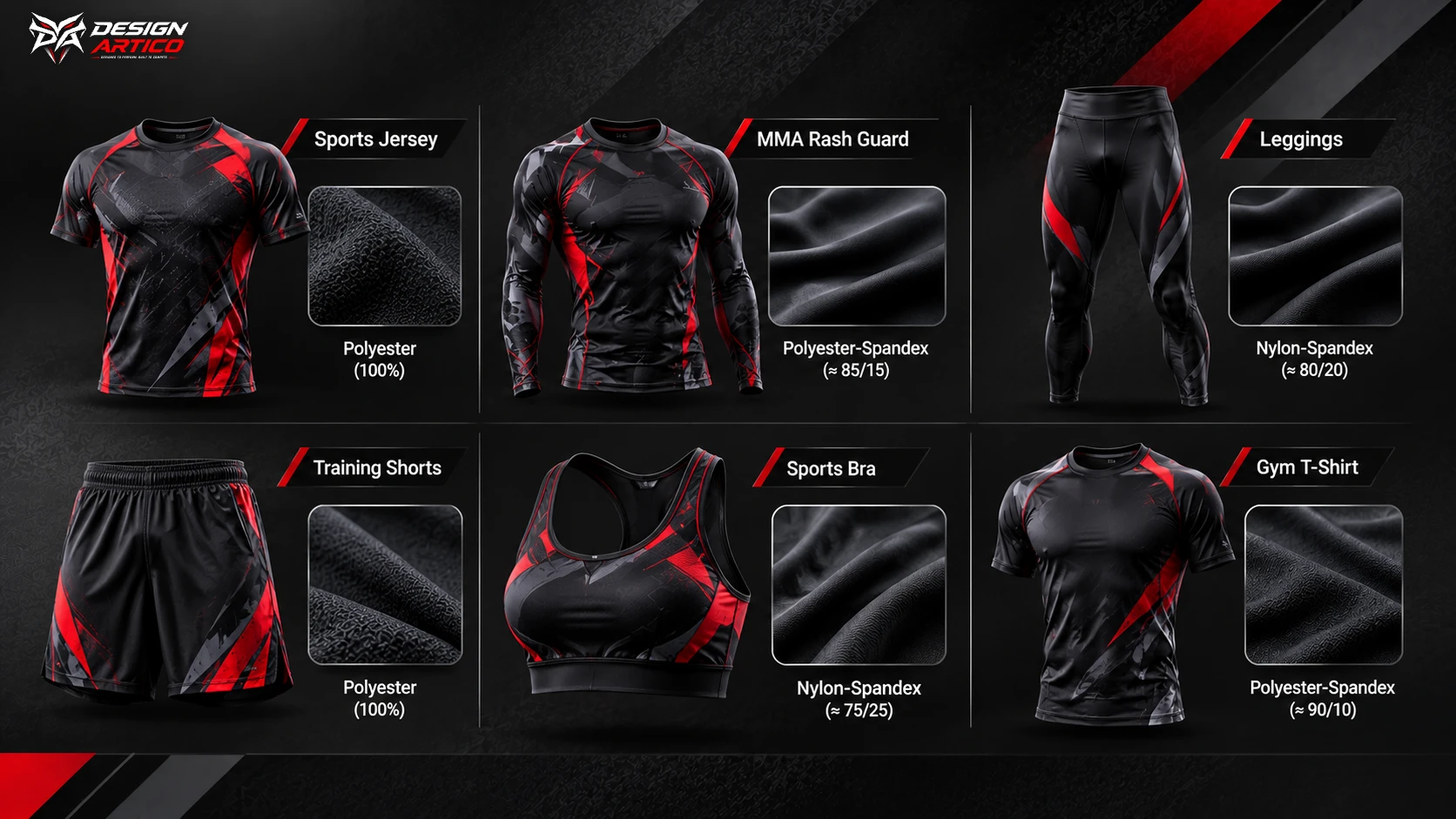
5. Which Fabric Is Best for Different Activewear Products?
There is no single best fabric for activewear that suits every sportswear product.
The right choice depends on the garment’s purpose, construction, comfort requirements and printing method.
Here is a practical guide:
| Apparel Product | Fabric Option to Consider |
|---|---|
| Sports jerseys | Polyester |
| Performance T-shirts | Polyester or polyester-spandex |
| MMA rash guards | Polyester-spandex |
| BJJ rash guards | Polyester-spandex or nylon-spandex |
| Compression leggings | Nylon-spandex or polyester-spandex |
| Gym shorts | Polyester or polyester-spandex |
| Yoga leggings | Nylon-spandex |
| Sports bras | Nylon-spandex or polyester-spandex |
| Running tops | Performance polyester blends |
| Training apparel | Polyester-spandex |
These are starting points for development, not fixed manufacturing rules. Actual specifications should be selected after testing samples.
6. What Is GSM and Why Does It Matter?
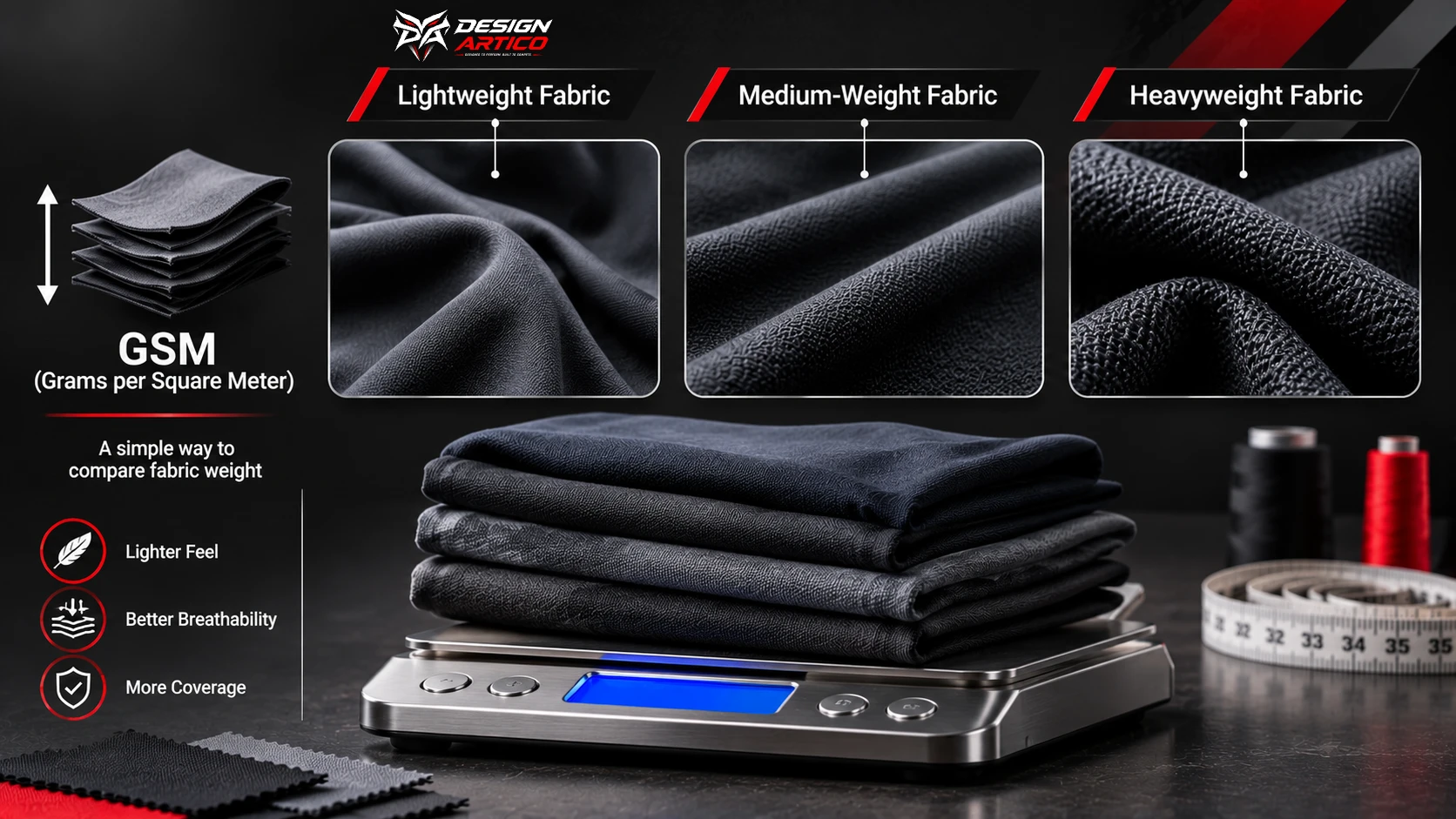
GSM stands for Grams per Square Meter. It measures the weight of a fabric per square meter.
GSM is an important specification in apparel manufacturing because it helps brands compare fabric weights.
For example:
- Lower GSM fabrics are generally lighter.
- Medium GSM fabrics can offer a balance between weight and coverage.
- Higher GSM fabrics are generally heavier.
However, higher GSM does not automatically mean better quality.
Two fabrics with the same GSM can feel and perform differently because of their fiber composition, yarn, knitting structure and finishing.
What should apparel brands consider?
Before selecting a fabric, evaluate:
- GSM
- Fabric composition
- Stretch percentage
- Recovery
- Thickness
- Opacity
- Breathability
- Intended garment application
For fitted leggings or compression garments, opacity and recovery are particularly important.
For performance T-shirts, weight and moisture-management properties may be more relevant.
7. Understanding Four-Way Stretch
Stretch is an important consideration for fitted sportswear.
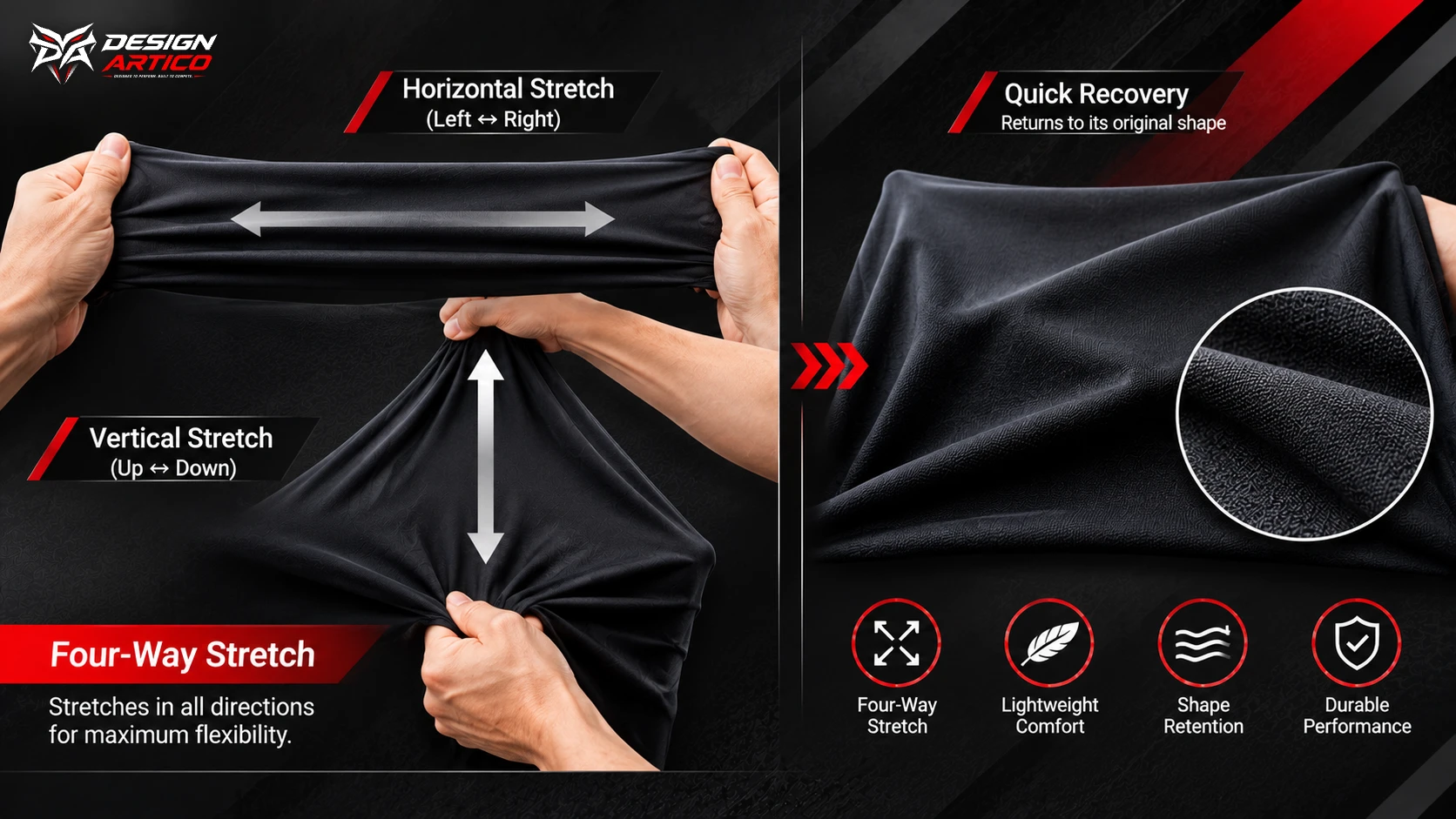
Four-way stretch means a fabric can stretch in both the lengthwise and widthwise directions.
This can be useful for garments that need to accommodate a wide range of body movements.
Common applications include:
- MMA rash guards
- Compression shirts
- Leggings
- Yoga apparel
- Sports bras
- Fitted training wear
However, stretch alone is not enough.
You should also evaluate stretch recovery.
A fabric might stretch significantly but fail to return to its original dimensions after repeated use.
For this reason, manufacturers should test both stretch and recovery before approving a fabric for production.
8. Is Polyester Better for Sublimation Printing?
If you are developing custom sportswear with full-color graphics, fabric selection becomes especially important.
Sublimation printing is commonly used with compatible polyester-based fabrics.
The process uses heat to transfer dye into the material, producing detailed graphics that become part of the printed textile rather than forming a conventional surface layer.
Why polyester is commonly selected
- Suitable for sublimation dye transfer
- Supports detailed full-color artwork
- Useful for large printed panels
- Suitable for custom sportswear graphics
- Available in various knitted constructions
What about nylon?
Nylon is not the standard choice for conventional polyester sublimation. Specialized dyes, coatings and processes may be needed for other materials.
Always confirm printing compatibility before finalizing fabric specifications.
A practical example
If you are manufacturing a custom sublimated MMA rash guard, a suitable polyester-spandex fabric may be a practical starting point.
If you are developing premium leggings, a nylon-spandex fabric may be worth evaluating when softness and close-fitting comfort are priorities.
The correct decision depends on the product and its intended production method.
9. Common Mistakes When Selecting Activewear Fabrics
Even experienced apparel brands can make mistakes when choosing materials. Here are some common issues to avoid.
Mistake 1: Choosing fabric based only on price
Cheap material can create problems with fit, comfort, durability and overall product quality.
Mistake 2: Ignoring stretch recovery
A fabric that stretches but does not recover properly may lose its intended fit.
Mistake 3: Selecting the wrong printing material
Not every fabric is suitable for every printing technique.
Mistake 4: Ignoring GSM
Fabric weight can influence garment appearance, coverage and comfort.
Mistake 5: Skipping physical samples
Digital specifications cannot tell you everything about the actual fabric.
Mistake 6: Assuming fiber composition guarantees performance
A polyester fabric from one supplier may perform differently from another polyester fabric because of differences in construction and finishing.
10. How to Test Fabric Before Bulk Manufacturing
Before placing a bulk order, request fabric samples and evaluate them. Here is a practical fabric testing checklist:
| Test | What to Evaluate |
|---|---|
| Composition | Fiber percentages |
| GSM | Fabric weight |
| Stretch | Lengthwise and widthwise extension |
| Recovery | Return to original dimensions |
| Hand feel | Softness and surface feel |
| Opacity | Coverage under stretching |
| Breathability | Air permeability |
| Printing | Color and graphic quality |
| Washing | Appearance after care testing |
| Durability | Resistance to wear and abrasion |
For technical sportswear, the manufacturer should help identify suitable tests for the intended garment.
Where performance claims matter, use measurable test methods rather than relying only on visual inspection.
11. How DesignArtico Helps With Activewear Design
Selecting the correct fabric is only one part of developing a professional sportswear product.
Your garment also needs suitable artwork, fit considerations, technical layouts and production-ready design files. Learn more in our guide on how to design custom activewear that actually performs.
DesignArtico provides custom apparel design services for brands developing:
- MMA rash guards
- BJJ rash guards
- Performance T-shirts
- Gym wear
- Sports jerseys
- Compression apparel
- Leggings
- Custom activewear collections
Our design workflow focuses on preparing professional apparel artwork with manufacturing requirements in mind.
From sublimation graphics and garment panel layouts to editable production files, the goal is to help apparel brands move from an initial concept towards a properly developed product.
Planning your next activewear collection? Contact DesignArtico to discuss your custom apparel design requirements.
Frequently Asked Questions
What is the best fabric for activewear?
There is no single best fabric for all activewear. Polyester, nylon and spandex blends are common choices depending on stretch, comfort, durability, moisture management and garment application.
Is polyester or nylon better for gym clothes?
Polyester is widely used for performance T-shirts and sportswear, while nylon is often considered for fitted apparel and leggings. The best choice depends on the fabric construction and intended use.
Is spandex good for sportswear?
Yes. Spandex provides elasticity and stretch recovery, making it useful in compression garments, leggings, rash guards and fitted training apparel.
What is the best fabric for MMA rash guards?
Polyester-spandex and nylon-spandex blends are both options worth evaluating. For sublimated designs, compatible polyester-based fabric is generally the more practical choice.
Can nylon be used for sublimation printing?
Standard polyester sublimation is not directly interchangeable with nylon printing. Specialized printing processes or compatible coatings may be necessary.
What does GSM mean in activewear?
GSM means Grams per Square Meter. It measures fabric weight and helps manufacturers compare material specifications.
What is four-way stretch fabric?
Four-way stretch fabric stretches in both lengthwise and widthwise directions, making it useful for garments requiring flexibility and body movement.
Conclusion
Choosing the best fabric for activewear requires understanding the characteristics of polyester, spandex and nylon.
Each fiber serves a different purpose:
- Polyester: A versatile base for many performance garments and sublimated sportswear.
- Spandex: Provides elasticity and stretch recovery.
- Nylon: Offers strength, abrasion resistance and a smooth hand feel.
For many sportswear products, blended fabrics provide a practical combination of these properties.
The most important thing is to select materials according to the garment’s intended use, then verify their performance through physical samples and appropriate testing.
Good activewear starts with the right material, but successful apparel development requires the right combination of fabric, fit, design and manufacturing.
POPULAR POSTS
How to Choose the Right Clothing…
How to Choose the Right Clothing Manufacturer for...
How to Design Custom Activewear That…
Custom activewear needs to do more than look...
How to Design a Custom Rash…
What Is a Custom Rash Guard? A custom...
What Makes a High-Quality MMA Rash…
An MMA rash guard is more than just...
Polyester vs Spandex vs Nylon: Which…
Polyester vs Spandex vs Nylon: Which Fabric Is...