

Choosing between sportswear printing methods is an important part of developing high-quality custom sportswear. In fact, the printing technique affects how a design looks, feels, stretches, and performs during training or competition.
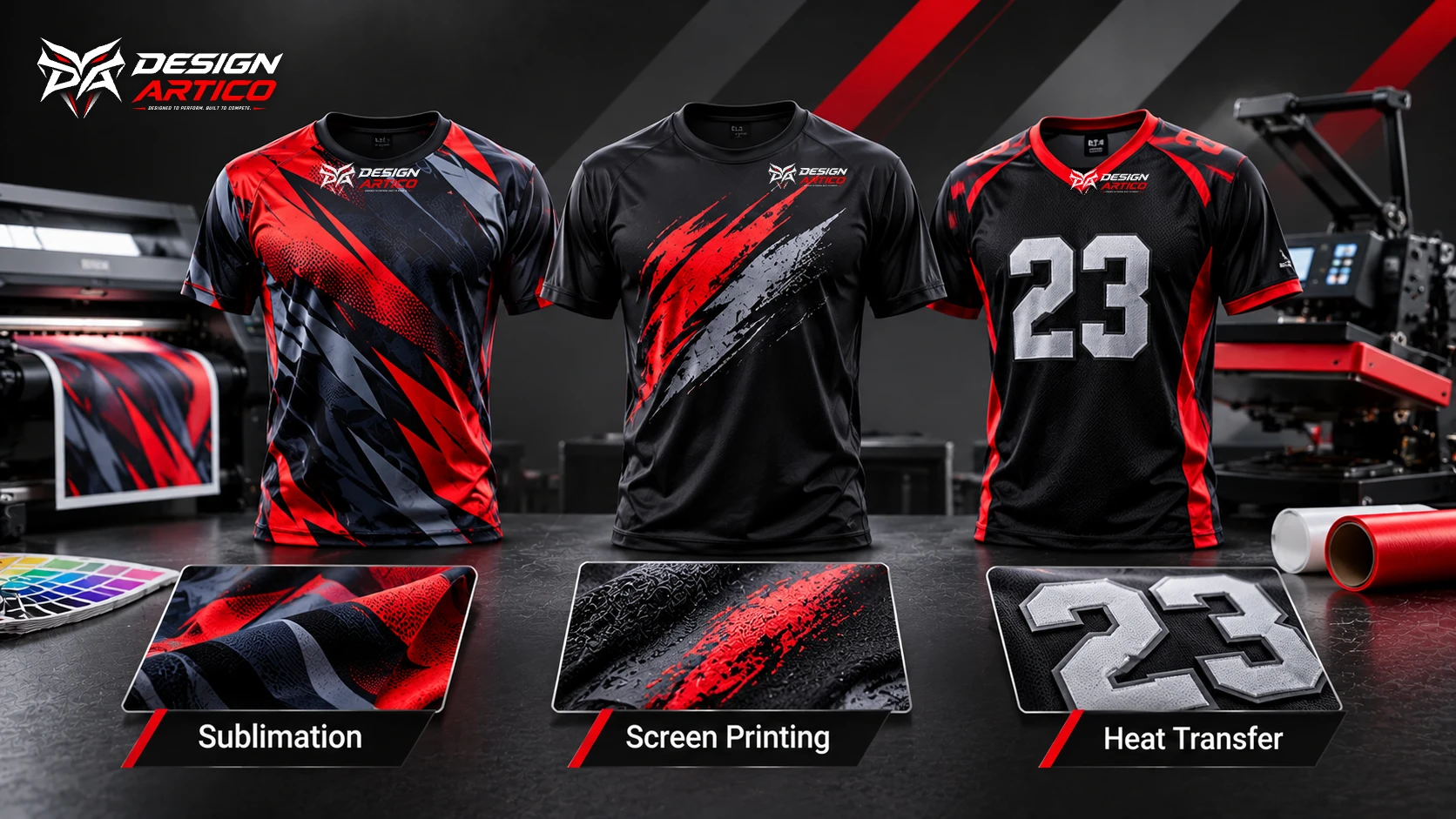
Three commonly used methods are sublimation printing, screen printing, and heat transfer printing. However, each has different strengths, limitations, fabric requirements, and production considerations.
Whether you are creating custom team jerseys, MMA rash guards, gym apparel, or branded activewear, understanding these methods can help you choose the right solution for your product.
In this guide, we compare these three sportswear printing methods and explain when each one makes sense.
1. What Is Sublimation Printing?
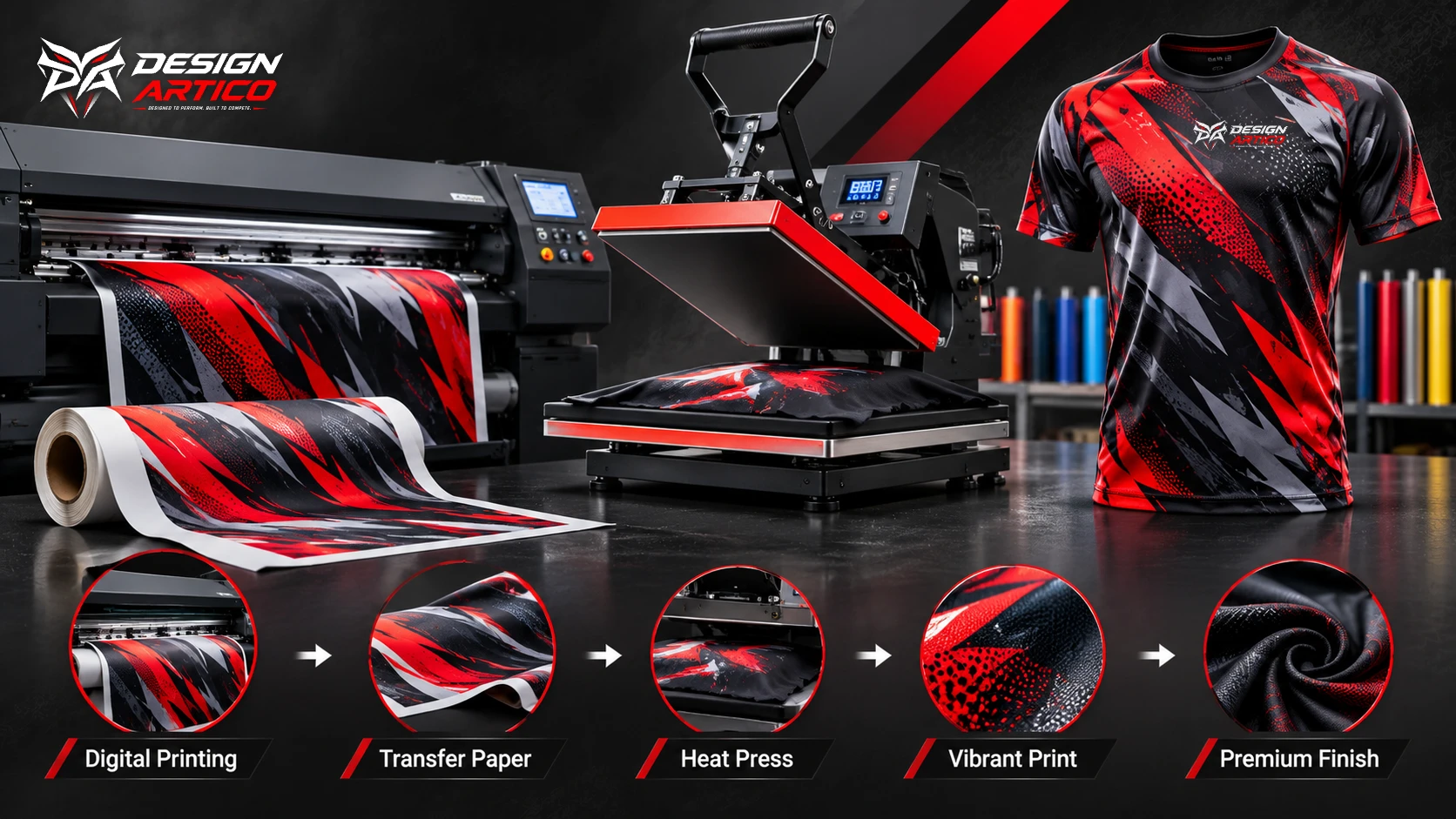
Sublimation printing is a process in which specially formulated ink is converted into gas through heat and pressure. Then, the ink bonds with compatible polyester fibers, becoming part of the fabric rather than forming a separate layer on top.
As a result, sublimation is especially useful for full-color sportswear designs. Learn more about the underlying technology in this overview of dye-sublimation printing.
Main advantages:
- Supports detailed artwork, gradients, patterns, and multiple colors.
- Does not create a thick printed layer on the fabric.
- Works well for all-over garment graphics.
- Suitable for polyester-based performance apparel (see our guide to polyester vs spandex vs nylon for activewear).
- Can maintain a lightweight fabric feel when properly produced.
Limitations:
- Standard sublimation is primarily suitable for compatible polyester fabrics.
- It is not generally suitable for printing directly onto ordinary cotton.
- Also, white areas are usually created by leaving the fabric unprinted.
- Print appearance depends on fabric color, coating, and production settings.
Best applications: Sports jerseys, polyester training shirts, sublimated shorts, and many polyester-based rash guards.
2. What Is Screen Printing?
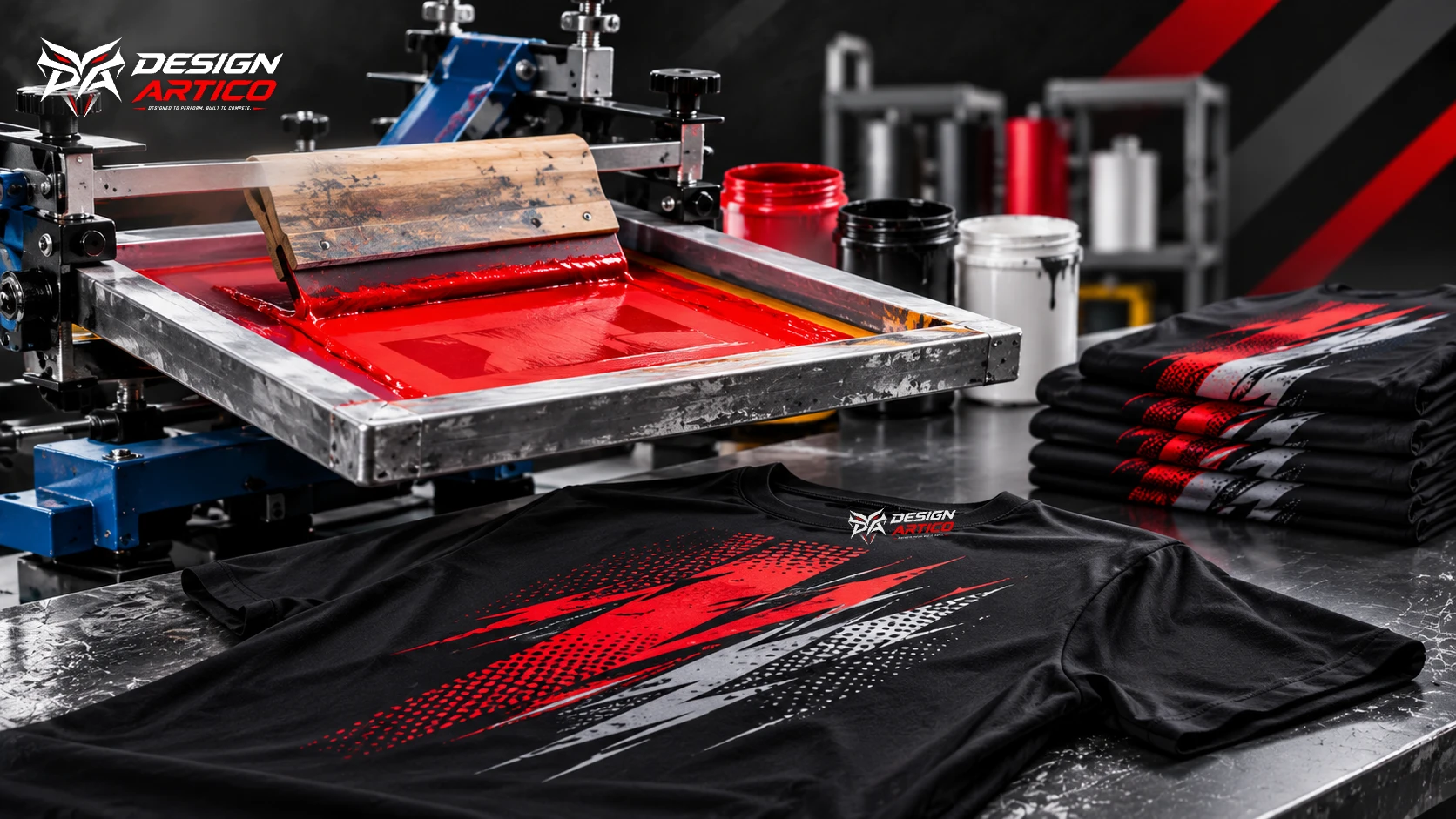
Screen printing uses a mesh screen and a stencil to transfer ink onto a garment. In addition, each color generally requires its own screen, making the method particularly useful for repeat designs with a limited number of colors.
For this reason, it is widely used for logos, team names, promotional apparel, and simple graphic designs.
Main advantages:
- Suitable for bold graphics and solid-color artwork.
- Can be cost-effective for larger quantities of repeated designs.
- Offers a wide range of ink types and finishes.
- Works on various garment materials when the correct ink and process are selected.
Limitations:
- Multiple colors can increase setup time and production costs.
- Complex gradients and photographic artwork can be more difficult to reproduce.
- Moreover, some ink applications create a noticeable layer on the garment.
- Stretch performance depends on the ink formulation and application.
Best applications: Team logos, simple jersey graphics, cotton promotional shirts, and selected sportswear branding applications.
3. What Is Heat Transfer Printing?
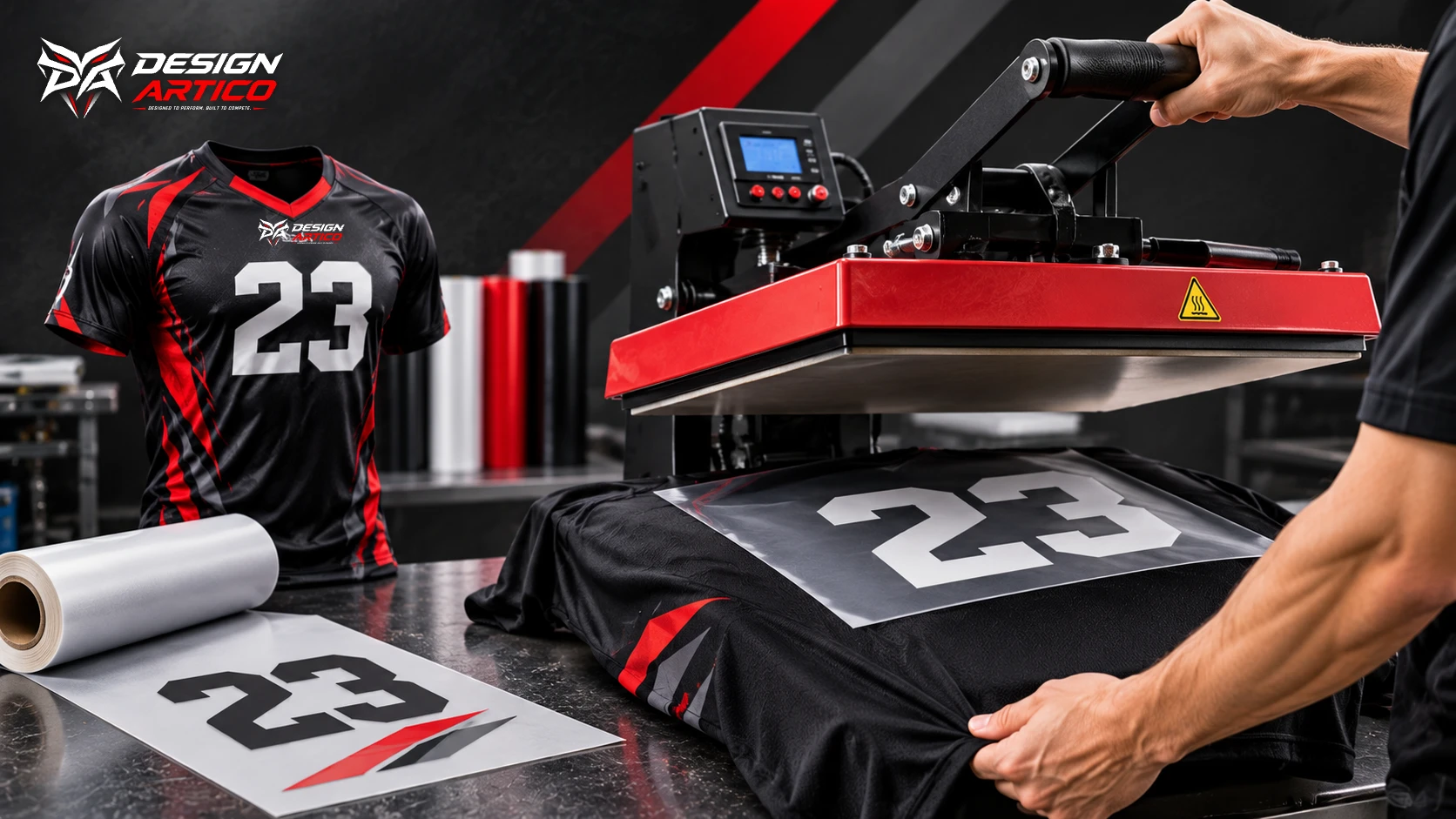
Heat transfer printing describes methods that apply a printed or cut design to a garment using heat and pressure.
Depending on the technology, the design may be transferred through a carrier film, printed transfer material, or specialized transfer paper.
Examples include:
- Heat transfer vinyl (HTV).
- Direct-to-film (DTF) transfers.
- Other specialized heat-applied transfer systems.
In practice, these methods are useful for adding names, numbers, logos, and smaller graphics to finished garments.
Main advantages:
- Suitable for names, numbers, and personalized designs.
- Useful for smaller production runs.
- Supports different graphic styles and finishes.
- Can be applied to selected fabric types when the transfer system is compatible.
Limitations:
- The design may create a layer on the garment surface.
- Durability depends on transfer material, application settings, and garment care.
- In addition, large graphics may affect flexibility or comfort.
- Stretch compatibility must be checked for compression garments and activewear.
Best applications: Player names, team numbers, small logos, personalized apparel, and selected branding details.
4. Sportswear Printing Methods Compared: Sublimation vs Screen Printing vs Heat Transfer
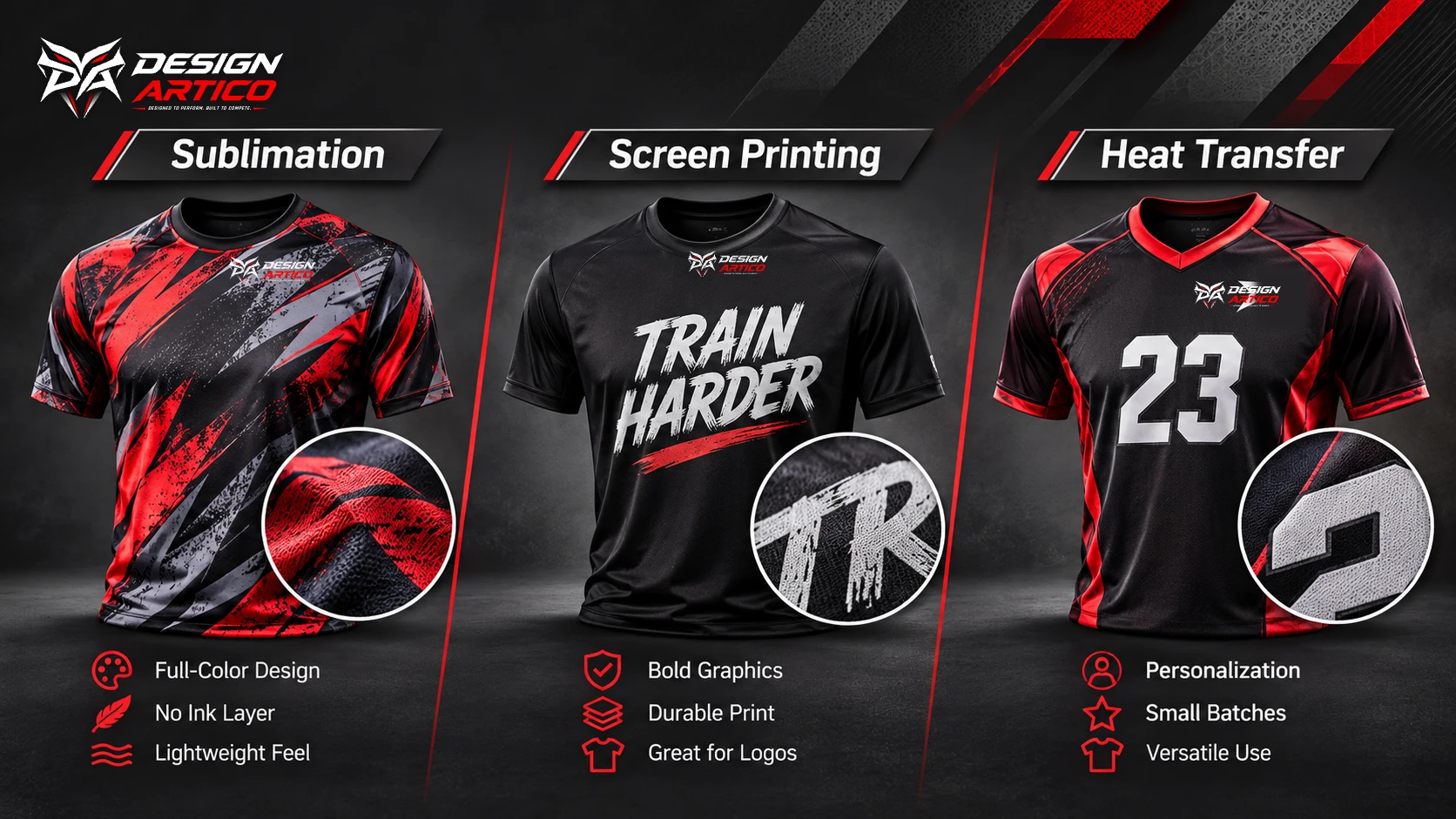
The table below compares the three sportswear printing methods side by side. Ultimately, the right method depends on the garment, fabric, artwork, quantity, and intended use.
| Comparison | Sublimation | Screen Printing | Heat Transfer |
|---|---|---|---|
| Full-color artwork | Excellent | More complex | Depends on transfer type |
| Gradients | Excellent | Limited or specialized | Depends on method |
| Surface feel | No separate ink layer | Usually has an ink layer | Usually has a transfer layer |
| Polyester compatibility | Excellent | Depends on ink | Depends on transfer |
| Personalization | Possible | Less convenient | Very useful |
| Large all-over graphics | Excellent | Less practical | Often less practical |
| Small logo application | Possible | Suitable | Suitable |
| Production setup | Artwork and print preparation | Screens and setup | Transfer preparation |
In short, no single method is best for every sportswear product. Instead, the correct choice depends on the requirements of the project.
5. Which Sportswear Printing Methods Work Best for Different Products?
Of course, different products have different performance requirements.
Sports jerseys: Sublimation is often a strong choice for polyester jerseys featuring full-color graphics, gradients, and all-over patterns. Similarly, screen printing and transfers can also work for selected logos and details.
MMA rash guards: Sublimation is commonly preferred for polyester-based rash guards because it supports detailed artwork without adding a separate printed layer. Read more about what makes a high-quality MMA rash guard. However, the fabric construction, stretch, and printing process should still be tested together.
Training shorts: Polyester shorts can be suitable for sublimation, while screen printing and transfers may be useful for simpler branding.
Leggings: Nylon-spandex and polyester-spandex leggings require careful selection of compatible printing systems. In other words, do not assume standard polyester sublimation will work on nylon-based fabric.
Gym T-shirts: Sublimation, screen printing, and heat transfers can all be appropriate, depending on the fabric, design, and order quantity.
6. What to Consider Before Choosing Sportswear Printing Methods
Before choosing between sportswear printing methods and finalizing production, review these important factors:
Fabric composition: Confirm whether the garment is polyester, nylon, cotton, or a blend. After all, printing compatibility depends on the actual material and process.
Stretch and recovery: For compression garments, the print must perform during repeated stretching and movement.
Artwork complexity: Full-color graphics and gradients may favor sublimation, while simple logos may be suitable for screen printing or transfers.
Production quantity: Screen printing may become more economical for larger repeat orders, while transfers can be useful for smaller personalized runs. Still, actual costs depend on setup and supplier pricing.
Wash durability: Request samples and test the finished print after repeated washing.
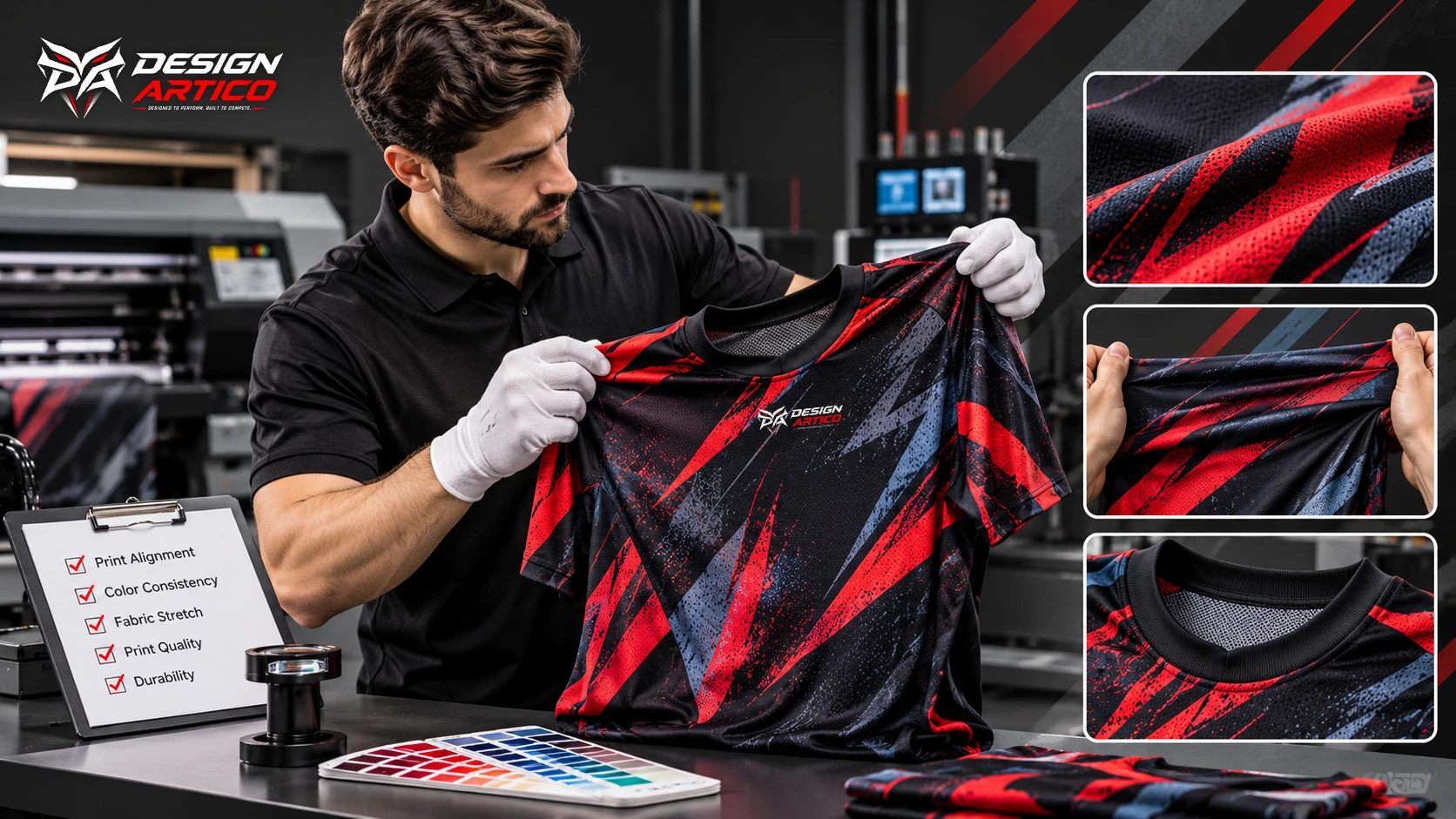
Production consistency: Check color accuracy, placement, alignment, and print quality across multiple garments.
7. Why Testing Your Sportswear Printing Method Matters
A design that looks good on a computer screen is not automatically ready for bulk production. Therefore, testing should always come before a large order.
For example, before approving an order, request a physical sample and evaluate:
- Print color and graphic sharpness.
- Fabric compatibility.
- Stretch and recovery.
- Print adhesion or bonding.
- Placement and alignment.
- Comfort during movement.
- Wash performance.
For multi-panel garments, also inspect how the artwork aligns across seams and panels. Above all, this is especially important for custom jerseys, rash guards, and fitted performance apparel.
8. How DesignArtico Helps With Sportswear Design
At DesignArtico, we help sportswear brands and apparel businesses develop custom garment graphics and production-ready artwork.
Our sportswear design services include:
- Custom sportswear and activewear graphics.
- MMA and BJJ rash guard designs.
- Sports jersey and teamwear designs.
- Sublimation artwork and panel layouts.
- Editable vector files and print-ready exports.
- Design preparation for different garment styles.
The printing method should be selected according to the fabric, garment construction, artwork, and manufacturer’s production capabilities.
Planning a custom sportswear collection? Contact DesignArtico to discuss your design requirements and prepare artwork for production.
Frequently Asked Questions About Sportswear Printing Methods
1. Which printing method is best for custom sportswear?
Among the main sportswear printing methods, sublimation is often a strong choice for polyester sportswear with detailed, full-color designs. Screen printing and heat transfer are useful for other graphics and applications.
2. Is sublimation better than screen printing?
Neither method is universally better. Sublimation is particularly useful for all-over polyester designs, while screen printing can be practical for bold graphics and repeated designs.
3. Can sublimation be used on nylon fabric?
Standard sublimation is designed primarily for compatible polyester. Therefore, nylon may require specialized inks, coatings, or alternative printing methods.
4. Is heat transfer suitable for stretchy sportswear?
Some transfer materials are designed for stretch fabrics. However, flexibility, adhesion, and wash durability should be tested on the actual garment.
5. Which method is best for MMA rash guards?
Sublimation is commonly used for polyester-based MMA rash guards because it supports detailed graphics without creating a separate surface layer. Even so, the complete fabric and printing combination should be tested.
6. Which printing method is best for small orders?
Heat transfers can be useful for smaller orders and personalization. Likewise, sublimation can also work for custom production, depending on the supplier and setup.
Conclusion: Choosing the Right Sportswear Printing Methods
Sublimation, screen printing, and heat transfer are the three most common sportswear printing methods, and each has a place in sportswear manufacturing.
Sublimation is particularly suitable for detailed polyester sportswear graphics. Meanwhile, screen printing is useful for bold and repeat designs, while heat transfer offers flexibility for names, numbers, and selected branding applications.
Ultimately, the best decision comes from matching the printing method to the fabric, garment, artwork, production quantity, and performance requirements.
DesignArtico — Designed to Perform. Built to Compete.
POPULAR POSTS
How to Choose the Right Clothing…
How to Choose the Right Clothing Manufacturer for...
How to Design Custom Activewear That…
Custom activewear needs to do more than look...
How to Design a Custom Rash…
What Is a Custom Rash Guard? A custom...
What Makes a High-Quality MMA Rash…
An MMA rash guard is more than just...
Polyester vs Spandex vs Nylon: Which…
Polyester vs Spandex vs Nylon: Which Fabric Is...
Sublimation vs Screen Printing vs Heat…
Choosing between sportswear printing methods is an important...